Neville meets Ruth
I Am LegendRobert Neville's encounter with Ruth is a decisive reversal in his solitary existence: after years spent surviving the plague and mourning Virginia Neville, he sees a living woman crossing an open field in daylight. The meeting briefly restores the possibility of human connection, yet it begins in mutual terror and carries the unresolved pressure of Robert Neville's earlier losses.
Causes and Background
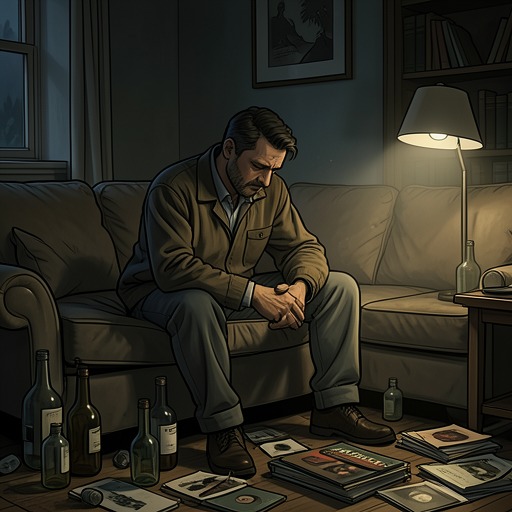
The encounter occurs after Robert Neville has been shaped by repeated bereavement. He has buried Virginia Neville rather than surrender her body to the mandated flames, sewing her into a blanket before carrying her to the ground. The burial does not end his attachment to her. He dreams about Virginia Neville so violently that he cries out in sleep, and memories of Kathy Neville's death return as a physical scene of fire, abduction, and helpless horror. His grief eventually hardens into emotional self-protection: he drinks, lies in darkness, and tries to reduce existence to an anesthetized present.
The loss of companionship has also made every possible living contact disproportionately important. When Robert Neville finds a dog, he treats it as more than an animal, calling it the peak of a planet's evolution; the dog's death leaves him unable to eat, drink, or sleep. He later comforts the sick animal and promises that it will recover, only to lose it within a week. Ruth therefore appears against a long sequence of failed attachments. She is not merely a stranger in the field but the first human presence to challenge the emotional vacancy Robert Neville has deliberately constructed.
What Happens
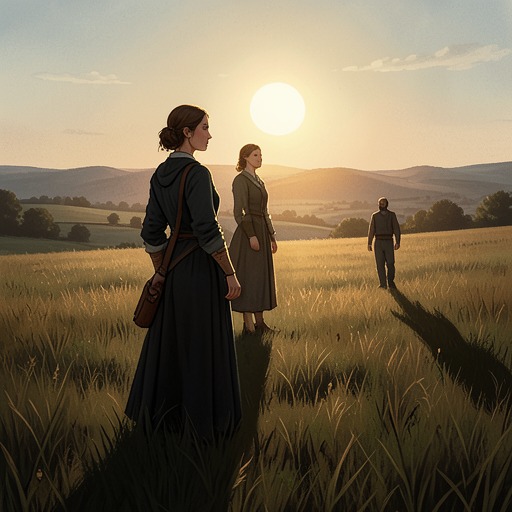
Robert Neville is sitting outside his house when a white spot in the distant field begins to move. At first he cannot identify it. When he realizes that it is a woman, the sight overwhelms his accustomed restraint. He blinks, shades his eyes, and watches her reddish hair, dirty white dress, and sun-tanned figure. The crucial fact is that she is alive and walking in daylight, a condition that makes her seem almost impossible after three years of isolation.
His uncertainty is immediate. Robert Neville considers whether the woman is a hallucination produced by his hunger for companionship, much as a dying man might imagine water. Yet the possibility of unreality does not prevent him from acting. He raises his arm and calls, “Hi!” The woman looks toward him, then turns and runs wildly across the field. Her flight transforms an apparently hopeful sight into a pursuit shaped by panic.
Robert Neville follows because he cannot accept the sudden disappearance of a living companion. He is faster and soon catches up, while the woman repeatedly looks back with terrified eyes. He tries to reassure her by crying, “I won’t hurt you!” but his words have little force against his appearance: he is a six-foot-three, heavily bearded man emerging from years of solitude. When he catches her shoulder, she twists away, falls, and struggles to escape.
The struggle becomes violent. Ruth claws at him and kicks him, and Robert Neville responds in rage by striking her across the face. The blow immediately exposes the distance between his intention and his conduct. Ruth collapses, crying and shielding her head as though expecting further violence. Robert Neville then regains control, tells her to stand, and insists that he is not going to hurt her. The meeting has moved from miraculous recognition to physical coercion, leaving both people frightened and unable to treat the other as safe.
Recognition and First Contact
Once the first shock passes, the two stand facing each other in the hot field, breathing harshly. Robert Neville has imagined such a meeting for years, but the reality is nothing like his dreams. The discrepancy matters: fantasy had preserved companionship as an uncomplicated answer to loneliness, whereas the actual encounter contains fear, damaged clothing, aggression, and the difficulty of speech after prolonged isolation.
Robert Neville asks the woman's name. She initially remains silent, trembling as she studies his face, and flinches when he raises his voice. At last she answers, “R-Ruth.” Hearing the name releases an emotional force that his earlier actions had suppressed. Questions disappear, his heart beats heavily, and he nearly cries. The scene closes with Robert Neville and Ruth standing opposite one another in the field, no longer an entirely unknown figure and a pursuing stranger, but two named human beings confronting the possibility of connection.
Consequences and Emotional Meaning
Ruth's arrival interrupts Robert Neville's deliberate numbness. He has tried to live without the heights of joy or depths of despair, but the sight of a woman alive in daylight revives both hope and vulnerability. His response is therefore double-edged: he reaches toward companionship with extraordinary urgency, yet that urgency helps produce the frightening pursuit that makes Ruth resist him. The encounter shows how isolation has damaged the very social instincts Robert Neville needs in order to overcome isolation.
The meeting also links Ruth to Virginia Neville rather than replacing the dead woman cleanly. Robert Neville later explains that he once mistook Ruth for his wife after waking and that Virginia Neville had returned from burial as a dead figure seeking his blood. He describes the horror of his own wife coming back in altered form, and the confession reveals why Ruth's presence carries both comfort and danger. Ruth resembles the outline of a lost attachment while remaining a separate person whose intentions Robert Neville cannot yet understand.
Despite the violence and uncertainty, the relationship temporarily becomes intimate. When Ruth comes close to him, Robert Neville draws her against him, and they hold each other tightly through the night. Her repeated use of his name and his physical embrace mark a fragile restoration of mutual recognition after years in which the dead, the infected, and animals have occupied the place of human society. The embrace does not erase the encounter's fear or its later implications, but it gives Robert Neville a brief experience of shared warmth and reciprocal dependence.
Narrative Significance
As an event, the encounter functions as a threshold between Robert Neville's solitary war against the infected and a new phase organized around another human being. Its apparent value shift is from absolute isolation to conditional companionship, but the shift is unstable from the beginning. Ruth is seen in daylight, speaks with a faltering human voice, flees like a frightened survivor, and later becomes emotionally close to Robert Neville; these contradictory signals prevent the meeting from becoming a simple rescue scene.
The scene also establishes a central irony of Robert Neville's survival. He has learned to protect himself from nocturnal threats, yet he is poorly prepared for the psychological consequences of meeting someone who might be an ally. His scientific vigilance, bodily strength, and determination cannot by themselves create trust. The first contact with Ruth consequently reveals that survival is not only a matter of resisting infection or defending a house; it is also the difficult recovery of a social self that grief and isolation have nearly extinguished.